


The past future of Simon Stålenhag

Aggiornamento: 6 dic 2021
Among the innumerable rivulets along which the production of science fiction is argued, one of those that I find most fascinating is what we can define as "decadent", dystopian, post-apocalyptic or generally post-any imaginary disaster. Here the stories, or graphic representations, do not propose space travels, aliens or futuristic wars, but show earthly, gloomy, melancholic settings, where there is a sense of unease, of defeat
A young Swedish artist, Simon Stålenhag, illustrator, designer and musician, is on the rise in this trend. His works depict a particular retro-futuristic reality, set in the 80s and 90s, but where we see the remains of a previous high technology fallen into disgrace, in disuse, and where the inhabitants live with this great failure, this step backwards, which makes everyday life empty, melancholic and sometimes distressing. So, in his panels we can find common 80's Volvos, kids with Walkman, and in the background the remains of what appears to us a futuristic structure, or a mega robot. This contrast, combined with the colors and style used, conveys to the viewer a strong sense of decadence, bewilderment and resignation.
The artworks are made with digital techniques, starting from photographs of landscapes taken by the author himself and used as background. The result resembles an oil painting, or gouache as the final rendering of colors, and manages to accentuate the dramatic nature of the scenes shown.
Stålenhag's works started out as single panels, published in various genre magazines, the great success they had led to the creation of a first book: "Loop", where the author combined the works and contextualized them: Sweden, 1980 - 1994, we follow the decay of the Loop, the world's largest atomic accelerator, built on a Swedish island between 1954 and 1969. The images describe the life of some teenagers around the ruins and remains of this now lost technology, reduced to rusty iron rubble, the daily scenes have a lot of autobiographical, being the author born in 1984. From this book is taken the Amazon Video series "Tales from the loop".
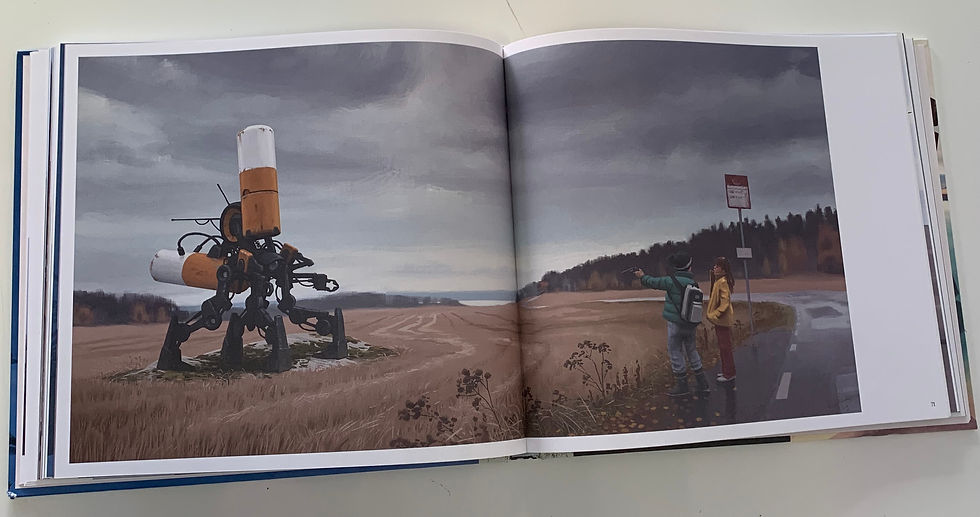

A second artbook, "Things from the Flood" covers the following years, between 1994, the year the Loop was finally decommissioned, and 1999. Here we also find plates illustrating unknown, monstrous life forms generated by a mysterious liquid rising up from the Loop's rubble

In these first two books, the images and the little text that accompanies them, while maintaining the thread given by the situation described above, remain anthological, describing characters, facts or mysteries without a real story to support them. Things change in the author's third work: "The electric state".

This one, the best in my opinion, is a true "graphic novel" where still the images are the absolutely preponderant part of the work. The set changes here we face imaginary post-apocalyptic United States in 1997, the rural Swedish landscapes give way to more urban, darker environments, but the protagonist's journey offers us many different scenarios.

The life described is more decadent from the point of view of the evolution of human being, the images are stronger and more distressing than in previous books. Strange and disturbing are the childish "cartoon" details that adorn ruined streets, abandoned robots or even strange creatures made of scrap metal.

This is surely the most mature and complete work, perfect to start "reading" and appreciating this author, who, as you can see on his own site (www.simonstalenhag.se) is ready to give us other fascinating images!
Matteo Russolillo
