


"If I want to show the world as it is, I have to invent it" - Hilma af Klint

Updated: Dec 1, 2021
The painter who painted the invisible: Hilma af Klint
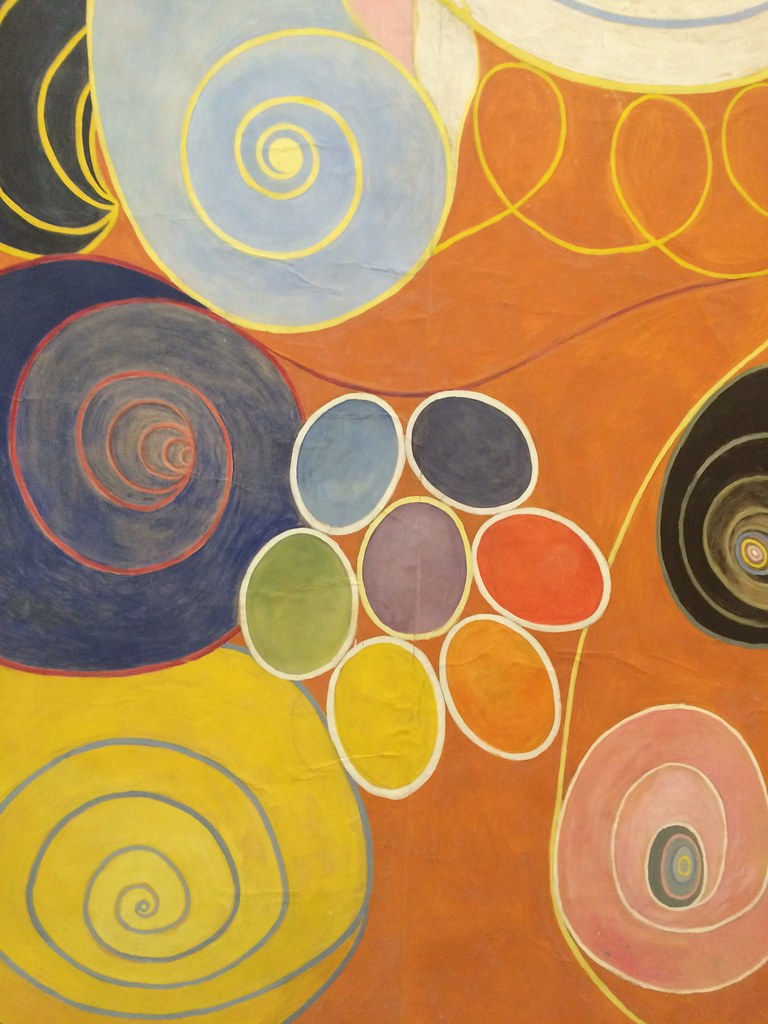
When we think of the word "abstractionism" in the art world, certain names immediately come to mind. Just type abstractionism into Wikipedia and you will find a section entitled "the world's leading artists of abstractionism" with Vassily Kandinsky, Piet Mondrian, Frantisek Kupka, Kazimir Malevich, Robert Delaunay and Paul Klee.
Without taking anything away from these talented artists who contributed so much to this artistic movement, but once again, it is a woman who can be considered the real mother of abstractionism, a true pioneer of this avant-garde and almost surreal current, but fortunately this time not because of a gender issue.
It was in fact the artist herself, Swedish artist Hilma af Klint, who lived her avant-garde work in total silence and isolation because she thought her contemporaries could not understand her.
She knew this, she was fully aware of her talent, her foresight and her 'visionary' art and that she and her works were destined for an audience of the future; in fact, Hilma forbade the exhibition of her works - we are talking about a production of more than 1200 paintings and 125 notebooks - for twenty years, a sufficient amount of time in her opinion for the community to evolve significantly. Unfortunately, she was too optimistic and her works remained in the
Unfortunately, she was too optimistic and her works remained in the warehouses of the Moderna Museet in Stockholm, because for its director Pontus Hultén, no one was interested in that kind of abstract art which was considered "unsaleable". They remained in those warehouses until 1986, when they made their debut, but more on that later.
Hilma began to cultivate a spiritual interest after the sad but pivotal event of the death at the age of 11 of her younger sister, whom she tried to contact through séances organised with a group of 4 friends, De Fem (The Five). At just 20 years old, she was one of the few women of her generation to be admitted to the Royal Swedish Academy of Fine Arts.
Initially Hilma's art was characterised by painting portraits and landscapes in a naturalist style that led her to become interested in botany, but later she devoted herself to representing the invisible when the first scientific discoveries were made in the early 1900s, such as the existence of atoms, X-rays, electromagnetic waves and particles.

Hilma, as an educated and sensitive woman, found in science and physics two instruments to represent what was not visible, such as atoms, of which the series of paintings "Atom" is an example, where she represents the atom in a process of development that moves towards unity and which can easily be compared to the spiritual path and goals Hilma aspires to. She continually superimposes concepts such as dark and light, good and evil, physics and matter, male and female, science and folklore.
What changed the course of her life, however, was the series of 193 works, 'Paintings for the Temple', to which she devoted herself completely from 1906 to 1915, convinced by the messages she received from contact with the heavenly spirits after sessions of meditation and spiritual exercises with her group of friends.

Unfortunately, even Steiner, the founder of the anthroposophical doctrine to which Hilma referred, advised her not to exhibit her works for at least 50 years as he did not understand or appreciate Hilma's revolutionary approach to art.
Unfortunately, as long as Hilma lived, none of her works saw the light of day, gathering dust in some family basement until they were inherited by the artist's nephew with two strict conditions: they were not to be sold or exhibited until 20 years after her death in 1944, following injuries sustained after being hit by a tram.
In 1986, as mentioned above, Hilma's works finally saw the light of day for the first time, making their international debut at the Los Angeles County Museum's exhibition The Spiritual in Art - Abstract Paintings 1890 - 1985. Since then, works by the Swedish artist, the mother of abstractionism, have been exhibited in museums throughout Europe. In 2013, the Moderna Museet in Stockholm dedicated its largest retrospective to her (with over 230 works) and in 2018 came the worldwide consecration with the exhibition "Hilma af Klint: Paintings for the Future" held at the Guggenheim in New York.
"Life is a farce if one person does not tell the truth". - Hilma Af Klint -
Even today, her works are still an attraction for art lovers or those approaching the artist for the first time. Fortunately, despite the fact that many museums are closed and it is difficult for us to see an exhibition or even just admire a painting or a small exhibition, museums do not lose heart and come up with digital alternatives to bring art into people's homes. At the Sydney Art Gallery, despite the temporarily closed doors, they are organising ways to learn, be inspired and get creative at home and online to explore the Hilma af Klint: The Secret Paintings exhibition online from home. explore the exhibition Hilma af Klint: The Secret Paintings online with Hilma af Klint at Home.
Ilaria Puddu

Comments