


MOCO Museum: Barcelona's irreverent museum

A modern, cosmopolitan and European city, Barcelona offers an art-loving tourist an embarrassment of options: from the well-known Casa Batlló, through Parc Güell and the Sagrada Familia without forgetting the Miró Foundation and the Picasso Museum.
In my last recent stay in Barcelona, after a splendid walk along the Barceloneta and Port Vell promenade, what caught my attention, a stone's throw from the Picasso Museum, almost by chance, was another little gem of this incredible metropolis.
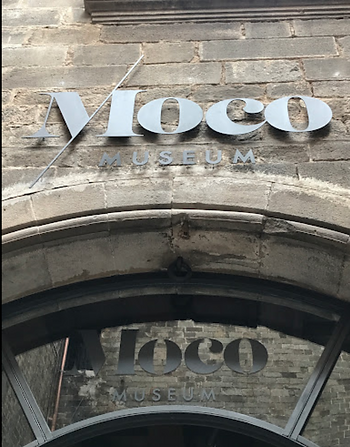
The Moco Museum (Museum of modern and contemporary art), a small independent museum, is located in a splendid palace (Palacio Cervelló) from the late Middle Ages (c. 1400 AD) in one of the city's most fashionable and central districts. As the name of the museum itself implies, works of modern and contemporary art can be found and admired there. Only, in retrospect, I found out that the one in Barcelona is not the only location and, there is an earlier and larger one in Amsterdam.
Passing by the museum, almost by chance I glanced at the inner courtyard and the colorful, friendly, and joyful style of the museum immediately piqued my interest. The young, dynamic, and, in some cases, decidedly attractive staff definitely pushed me to enter and visit.
From the first impression and a glance at the website, it is clear that the ambitious goal of this museum is to make art accessible to everyone and in particular to bring younger people such as millennials and Generation Z closer to it.

The choice of a medieval palace might seem jarring and unnatural to host modern and contemporary artworks. Instead, as soon as the exhibition begins, you realize the perfect harmony between the building, the exhibition venue, and the art objects inside, creating the perfect environmental conditions for admiring and appreciating what is on display.
In addition, the decision to opt for an essential, simple, and direct artistic language to captivate the visitor's attention and stimulate his imagination and senses at the same time is evident. The museum's exhibition layout thus allows the visitor to project himself inside the work of art through a visionary path based on perceptive aspects, trying to reduce the "distance" between the visitor and the work on display.
The works on display, some very irreverent and provocative, others instead imaginative, surreal and psychedelic are all, in my opinion, extraordinary for their ability to stimulate the interest of the observer and bring him existential and profound questions. The artists exhibited, some of whom are extremely well-known, including Andy Warhol, Jeff Koons, Keith Haring, Salvador Dali, Basquiat, Banksi and David Lachapelle, Hayden Kays, Nick Thomm, Studio Irma, Yayoi Kusama, Guillermo Lorca, Kaws and JR.
A pink canvas with the words "if you think sexuality is a choice, how do you explain the fact that women still like men?"; this work by Kays, ingenious, sarcastic, and irreverent, caught my opinion first and more than others. I instinctively thought it was created by a woman, but then I found out that he is the author of this provocative canvas. Hayden Kays is a young 36-year-old British artist, culturally influenced by both street art and pop art. Consoling, I thought, women will still like men for characters like him, resigning myself when I found out he is homosexual.

Among the many splendid and irreverent works on display, another one that caught my curiosity is 'The Last Supper' by David Lachapelle: caustic, mocking, pungent and a little blasphemous as I like it; this parody of Leonardo's famous 'Last Supper' cannot fail to stimulate brilliant, open-minded and critically-minded minds.

"Metamorphosis", psychedelic and colorful work by a young Australian "graphic designer", Nick Thomm, is positioned at an angle in one of the rooms on the ground floor. This canvas hypnotizes you, draws you to it, and pulls you towards it, giving you the feeling of wanting to be sucked into it. It is hard to turn your attention away from it, it keeps you there, in a vortex of extremely vivid and captivating tones ranging from the dark blue of the far left to the intense red of the far right.

In some cases, the works of specific artists are all collected in the same room, and this is the case of Chilean artist Guillermo Lorca Garcia-Huidor. Fairytale-like, moving but at the same time disconcerting, these canvases focus on the relationship between humans and animals, on the adaptability of living beings, on their resilience but also on their unease. The subjects of the paintings, mainly children and animals, portrayed in bucolic settings, give a reassuring, almost childlike sense of serenity, peace, and quiet. Gradually, however, this feeling soon turns into something grotesque, and finally into an uncontainable feeling of dismay and severe anguish.
The exhibition closes with a wonderful immersive art experience by Dutch artist Irma de Vries. The possibility of actively experiencing art characterizes immersive art. To do this, it uses modern technology and digital tools, allowing the art lover to be completely immersed in the work of art.
Thanks to a sophisticated alternation of light, color, sound, and music, this dynamic artistic creation stimulates not only the eye but all the senses. Thanks to an accurate and stimulating play of illusions, perceptual phenomena, and dreamlike references, the visitor actively perceives himself as part of the work and becomes aware of art as something alive, closer, and accessible to all.
As you will have guessed, I have only described the works that struck me most, favoring lesser-known and lesser-known artists, precisely to emphasize the spirit of this small independent museum that appears to be projected into the future, young and above all open to novelties and the promotion of young and promising artists. It will not be easy to realize the ambitious project of making art accessible to all and in particular to bring the new generations, constantly subjected to sensory hyperstimulation, closer, but Moco has certainly made a good start. And, as the saying goes, a person who starts well, is half the battle.

-