


Jago, the brave and ambitious artist who took art into space

Hyperrealism
/hˈaɪpɪɹˌiəlɪzəm/
masculine noun
Hyperrealism is an art movement born in the United States around 1970. It is a genre of painting and sculpture where artists aim for a reproduction of reality, using photographic techniques and mechanical reproduction.
The work of these artists is so real that you can see facial pores, epidermis lines, wrinkles or simple skin folds. All this, for example, sculpted on snow-white marble as if it had been carved like clay, plasticine or plaster.
I could see all this while admiring the works of the Italian sculptor, photographer, videomaker and musician, born in 1987, Jago, aka Jacopo Cardillo. You can check out his Instagram page @jago.artist.
I was at the exhibition in Bologna at Palazzo Albergati, from 11 November to 7 May 2023, where his works are being exhibited, together with 2 other well-known artists, Banksy, whose article Banksy: Art in the Shadows you can read here, and TvBoy.

I had often heard of Jago and his story, but I did not know him well. Often there is a prejudice and preconception when we go to someone's exhibition or performance, that someone may have special qualifications, or a prestigious academic background. But, if we think of several well-known important figures even from the last century we see that is not always the case. For example, Walt Disney dropped out of school and, before he became what we know now, he sold vacuum cleaners door to door; Or Einstein who had a very bad memory and failed his university entrance test having to take it over and over again. But he is nevertheless considered an undisputed genius of science, physics and mathematics. Or the more recent Steve Jobs with problems at school due to dyslexia. Even Bill Gates and Mark Zuckerberg have made a fortune out of their genius despite having dropped out of school.
Because in life sometimes it is necessary to dare and listen your inner voice, and to believe in it and not give in to those who tell us 'no, that's not right, you are not ready, you are not suited'.
And that is what Jago did. He did not have a qualification and dropped out of the Academy because his teacher had denied him the opportunity to exhibit at the Biennale, saying that he should be the one to decide whether he was ready or not, despite the fact that Jago had been invited by art critic Vittorio Sgarbi. Jago, however, was brave, he believed in his work, and he wanted to show it, and he did so, leaving the Academy and starting to follow his dream and those who believed in him.
He wanted so much to show what he did and how he did it that through the use of social media, he started to show the 'making of' his works. In fact, he says:
'the behind the scenes is sometimes more interesting than the work itself'
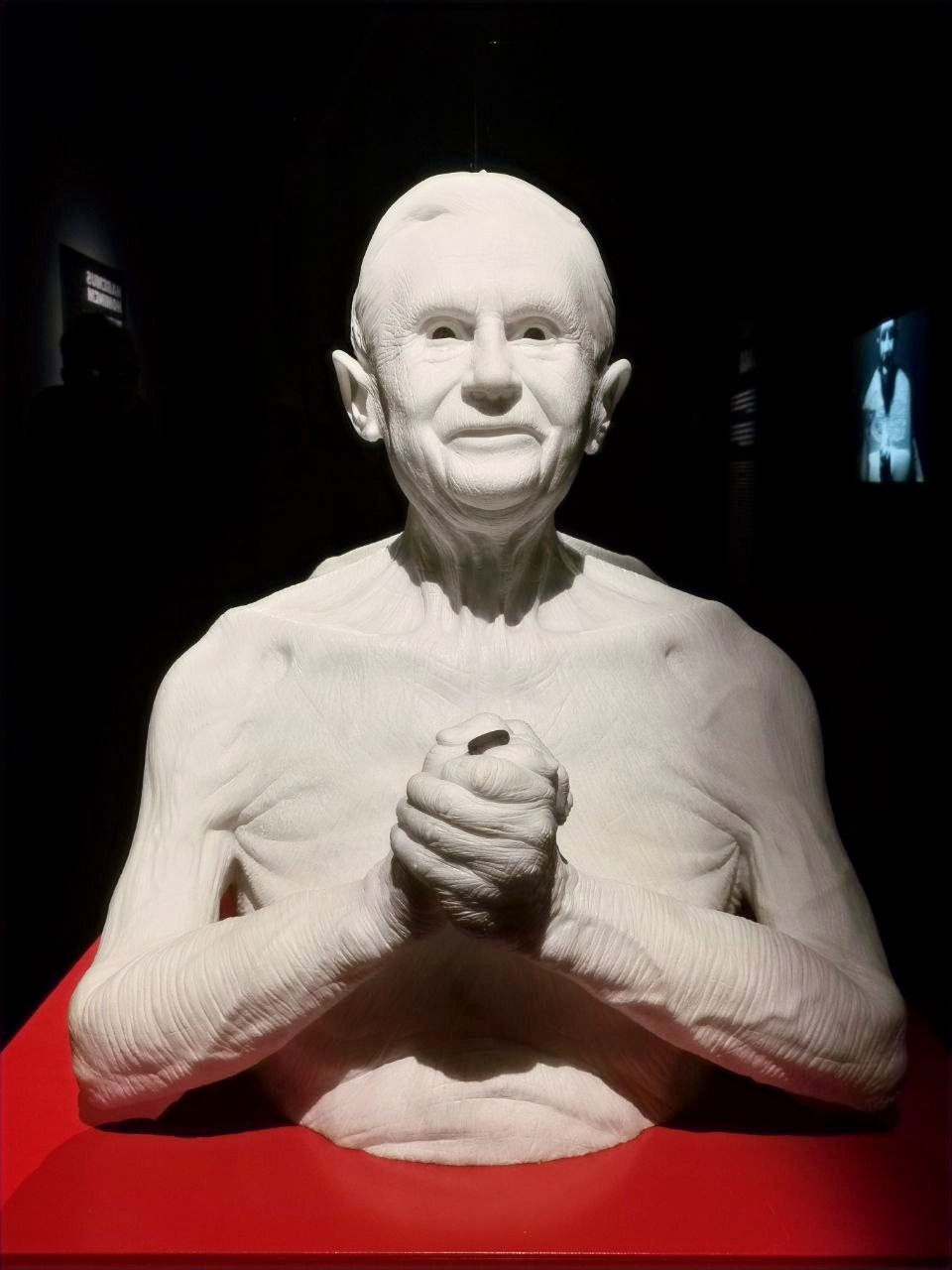
One of his works that impressed me the most was the reproduction of The Bust of Pope Benedict XVI and the story behind it.
Initially the Vatican did not like the piece because Jago had pierced the eyes. They asked him to fill them in because the Pope has a certain image, and the Vatican did not want to give him a disreputable image. Jago refused. He did not want to change the sculpture. He was convinced that the Pope did not like it, when in fact he had never even seen it.
One day while he was taking down the exhibition, Jago learned that the Pope had resigned. So just as the Pope had undressed, Jago decided to also undress his torso by removing his tunic. He also decided to fill in those eyes that had limited him at first by giving him sight. It is as if his eyes are moving, as you move, the eyes follow you.
Another sculpture that struck me at the exhibition, especially because of its history, is the first marble sculpture to go into space. The sculpture is called First Baby and is a small foetus of a child, symbolising the enormous potential of mankind. 'Set no limits to your ambitions; the sky will be your new starting point'. She went into space on the European Space Agencies' Beyond mission in 2019. It was entrusted to mission chief astronaut Luca Parmitano, who took the beautiful photo on the space base with Earth in the background. It has never happened in aerospace history that a sculpture could go into space. Jago is really powerful.

Another particular work that caught my attention is The Circulatory System, an installation with thirty ceramic hearts all in a circle, recreating the sequence of the individual movements of the heart muscle, the heart, for a single beat, while a video reproduces its dynamics and sound. I was fascinated and captivated by the sound of that beat while in front of me, those thirty shiny white hearts almost gave me the idea that they were really moving, beating in unison.
And finally, a very intense and thought-provoking sculpture, Jago's Venus.
Jago with his Venus tries to embody a concept of beauty linked to the inner character of the human soul and not to the usual banal exterior stereotypes. In fact, Jago's Venus is none other than an elderly woman who, with courage and without shame, displays the grace of a body whose beauty lies not in the perfection of its form but in the truth of what it proposes. Jago's Venus, in fact, speaks of a life lived, of a body that is now decaying but which retains its splendour by virtue of what it has been and what it has gone through. In this work, too, we find the detail of the eyes following the person who is watching her, as with the Pope. The old woman has a past, an experience to share and, enchanted by her magnetic eyes, the viewer finds himself listening to this woman's story while reflecting on his own.
Jago says that when people see his marble, they ask him if it is fake, if it is real, if it is made of resin, or if he has moulded it. Because they cannot conceive that stone can be take form in that way, because people only know the reality that way.
To amaze people and give them courage, was one of his goals and he succeeded very well
Jago says in a video: "Imagine if Michelangelo could have put the time-lapse video of the making of David on Facebook! Please! I want to see it! I fell in love with the greats because I was amazed that normal men, like me, with a brain, two eyes, but above all two hands, could do such incredible things on their own! And I said 'But I also want to do them! Me too!' If I as a child had not said inside myself 'I want to be stronger than Michelangelo, better, bigger than him!' I would never have gotten excited, I would never have started sculpting. Because seeing a person who can sculpt, a person who can draw, a person who can bring something into the world, like a child, gives courage. And that's what people need, courage! Art is a great opportunity to give people courage".
The exhibition was organised by Arthemisia with the collaboration of Piuma, Pop House Gallery and Apapaia. Curator of the exhibition Piernicola Maria Di Iorio, to whom we extend our best compliments for having exhibited Jago's works in the best possible way in order to appreciate their entire form and intensity.
