


When an artist creates flags: Alighiero Boetti

Aggiornamento: 6 dic 2021
Since I was a child I have been totally fascinated by flags of various countries, I used to spend a lot of time looking at the last pages of a geographic encyclopedia where they were all illustrated with the name of the relative country until I learned them all by heart. Even today; I am very interested in flags, their history, and meaning, symbols, and color combinations that always express much of the history of the country they represent. Through vexillology, the study of flags, you can understand a lot about the history of a single country, a geographical area, or even a whole continent. One of the first things a state does after a revolution, a liberation, a coup d'état, a separation, is to underline and communicate to the world the change, adopting a new flag. Looking at the flag of a state over the years we can see where it comes from, who it is inspired by, who conquered or governed it if the liberation was bloody or peaceful if this country embraces particular ideologies or political currents.
Another great passion of mine is maps, charts, planispheres. I want to introduce you to an artist who has combined these two elements, maps, and flags, elevating them to works of art: Alighiero Boetti.
Alighiero Boetti was born in Turin in 1940, he approached art as a self-taught, he reached his artistic "maturity" once he moved to Rome, in 1970, where he claims to have "discovered the color". A great lover of geography (he wrote together with his wife the book "Classifying the thousand longest rivers in the world") undertakes numerous trips around the globe: the Americas, Japan, Africa, and especially Afghanistan, a country that affects him deeply, where he will return several times, founding a business and especially giving rise to his most representative artistic production: the maps.

Boetti's maps are political planispheres where each country is depicted by its own flag, where a set of colors and symbols, which at first glance may seem confusing, faithfully represents the political and geographical situation of the world at the time of creation. Boetti realized about 150 maps in almost 20 years, starting from 1971. Through the observation of his works, we can see the historical and political evolution of the world through very eventful years and fundamental for the global geopolitical situation. One of the things that immediately jumps to the eye is the disappearance of the huge red spot resulting from the fall of the Soviet Union, for example, or the achieved autonomy of Greenland, which sees its flag replace the Danish one, an aspect that is very visible due to the choice of representation of the planisphere, with the projection of Mercator, where the areas farthest from the equator are extended.
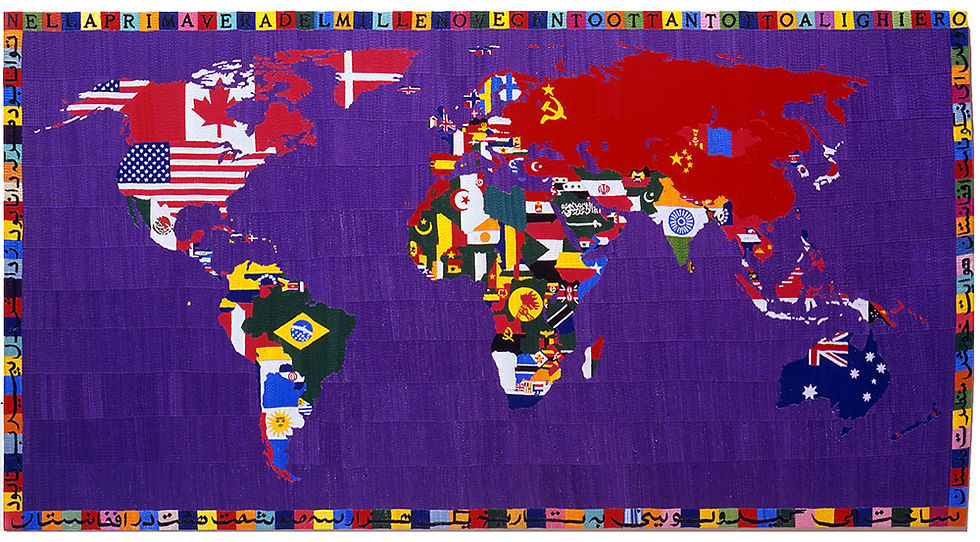


A singular aspect of these works is the realization, they are not painted, but all embroidered by hand: Boetti had the basic linen canvas prepared in Italy, where the borders of the individual states were drawn, the canvas was then entrusted to embroiderers in Afghanistan in Kabul, where the author went regularly at least twice a year to check the progress of the work. The embroidery could last for years, it was always carried out by Afghan women in Kabul, until 1980, when following the invasion of Afghanistan by the USSR, the work was entrusted to Afghan refugees in Peshawar, Pakistan. Each map has on its outline indications regarding the year and place of creation or other relevant information by the author, always in embroidery, with a style of writing without spaces and readable in different directions that we find in other works by Boetti, some also have inscriptions in Farsi language, as evidence of the place of origin.


For Boetti, who signs the maps as "Alighiero e Boetti" (Alighiero and Boetti) as if they were two separate people, the detachment between the author and the physical realization of the work is the ultimate exaltation of the work of art, this is how he describes it:
"The work of the embroidered map is for me the ultimate in beauty. I didn't do anything for that work, I didn't choose anything, in the sense that the world is made as it is and I didn't draw it, the flags are what they are and I didn't draw them, in short, I didn't do anything at all: when the basic idea emerges, the concept, everything else has not to be chosen."
The size of the maps are very variable, from 1.5 x 2 meters to very large works with sides up to 6 meters long, maps are currently exhibited in the world's most important museums, and have very high quotations, the last one was auctioned by Christie's at 1.5 million pounds.
So you can see how simple and common study elements such as flags and geography, can be elevated to art thanks to the brilliant intuition of an artist, who in his production has used other unusual objects such as stamps or postal marks, and maybe from today on you will observe the globe under a more imaginative light too.
Picture from: Archivio Alighiero Boetti www.archivioalighieroboetti.it
