


A journey through history to explore the most romantic square in Bologna: Piazza Santo Stefano

Sudden, a jolt, like the first meeting of an unforgettable love affair. I must have been 15 or 16 years old, but I still remember the first time I saw Piazza Santo Stefano. I would have spent so many evenings walking around, chatting, singing songs accompanied by some friends who were good at playing the guitar, sitting on the paving stones in front of the "Sette Chiese" (Seven Churches).

The complex of the 'Sette Chiese' is one of those magical places; every time I have been there and, for fun, I have tried to count the actual number of churches it was never the same as the time before and almost as if by a spell it was never seven but always more or less.
In fact, the name given to the complex is symbolic and the total number of churches is at least 12, built at different times. Of these, the one that has made this place famous since the Middle Ages is the Church of the Holy Sepulchre, built by the Crusaders in the 12th century. The octagonal plan of this building contains a miniature version of the complex of the Holy Sepulchre in Jerusalem, with the aim of allowing the possibility of a "different" and, above all, safer pilgrimage compared to that in the Holy Land. Almost entirely destroyed by the Hungarians in the 10th century, it was then rebuilt by Benedictine monks in the 11th century.

There is conflicting information about the origins of the complex, but it appears to date from around the 5th century. The first of the Sette Chiese (seven churches) to be built was that of San Vitale and Agricola (the one furthest to the left, with the two towers behind it), where the relics of the two saints were kept, and was supposedly built by Bishop Petronio on the ruins of a pre-existing pagan temple.
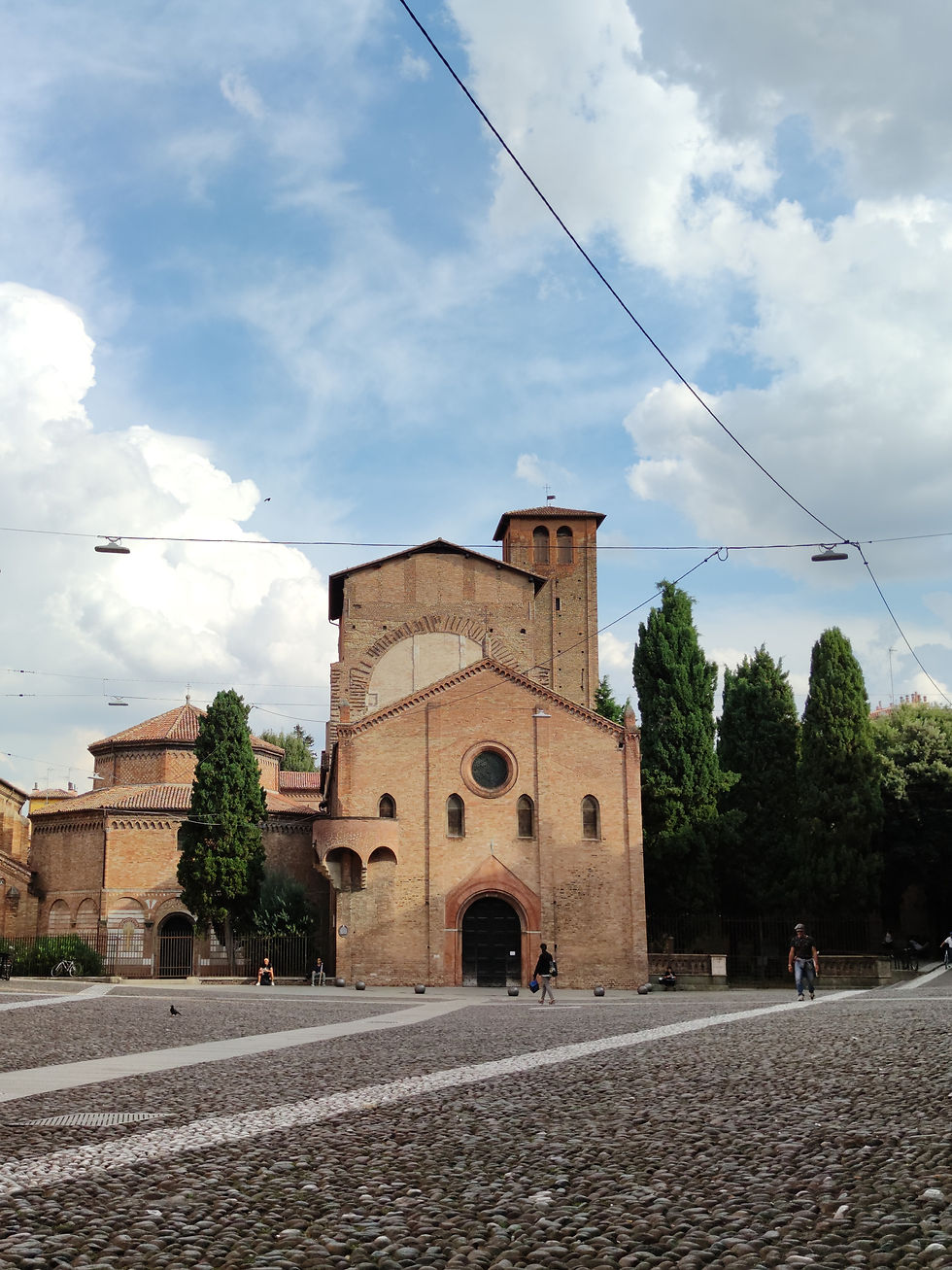
The "Del Crocifisso" (of the Crucifix) is the other church that overlooks Piazza Santo Stefano and is the one from which you usually enter the complex. This appears to date back to the 8th century and was built by the Lombards who wanted it as a cathedral. The facade, which is reminiscent of Romanesque architecture, is actually very different from what it originally looked like and is the result of numerous renovations, tampering and reconstructions. The presbytery of the church, formerly an independent church, that of St John the Baptist, was completely rebuilt in the 17th century in Baroque style, becoming part of "chiesa del Crocifisso" (the Church of the Crucifix).
The Medieval Cloister and the Courtyard of Pilate are two places within the complex where walking around has always given me the perception of being out of time, far from the stress, frenzy and excessively fast pace of our society. I have often imagined, as I did as a child in the Cloister of Monreale, the monks reflecting, praying and walking slowly in their brown cassocks.

With the complex of the Sette Chiese (Seven Churches) behind you, on your right you can see the marvellous architectural structure that includes Corte Isolani, another symbolic place of the city of Bologna. This ensemble of buildings, already consisting of the 'Lupari' and 'Bolognini' buildings, was acquired at different times by the 'Isolani' family, who made it the marvel we can observe today. In particular, I have always found sublime and enchanting the passageway that leads from Piazza Santo Stefano to Strada Maggiore under that splendid wooden vault with the three arrows embedded in it that fuel the legend of these places. I have often imagined that passage being walked by courtiers, rich lords, ordinary people but above all students from all ages.

In front of the Corte Isolani, you can see a series of marvellous fifteenth-century stately palaces as well as the well-known Palazzo Amorini Bolognini Salina, also famous for its friezes with terracotta heads. These can be seen on two levels; one row can be seen at portico level and the other on the top floor alternating with the small windows. This building is also known as the centre of Bologna's cultural life for centuries: in fact, the school of painting of Calvert and his pupil Guido Reni was here, as well as musicians such as Haydn or Rossini who performed their works.
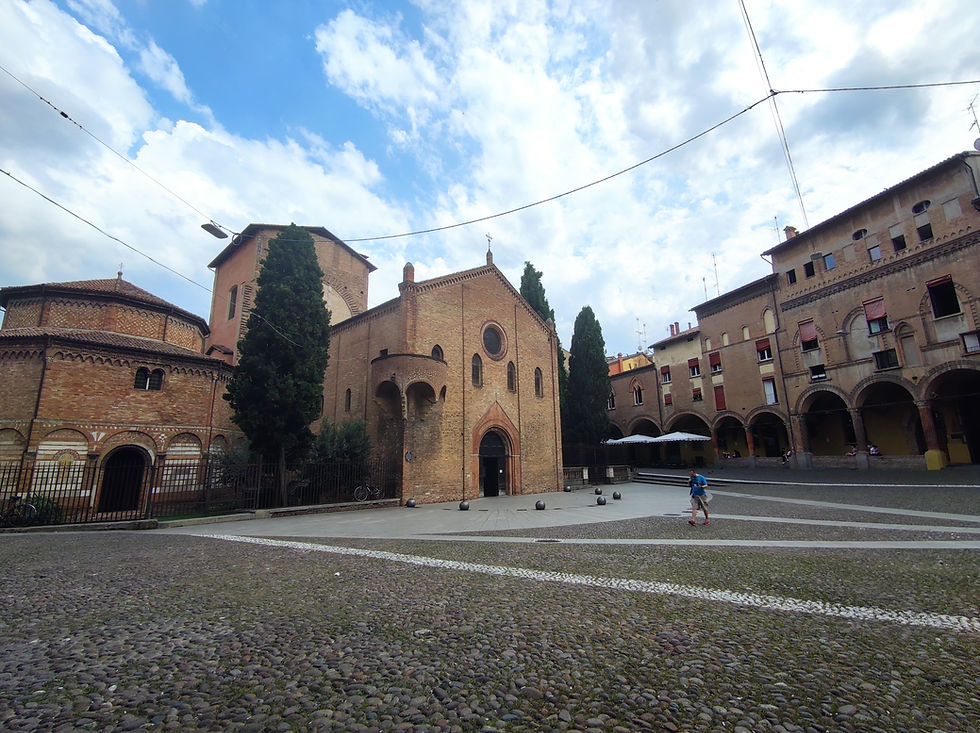
Now imagine walking, perhaps in the company of your sweetheart, through Corte Isolani and arriving from Strada Maggiore in Piazza Santo Stefano, imagine it in the 19th century, in the moonlight, with the notes of the "Barber of Seville" or "An Italian in Algiers" coming from Palazzo Amorini Bolognini. Don't you feel shivers? A sublime feeling already pervades my mind.
In fact, what would not even be a real square but rather a widening of Via Santo Stefano, with its wonderful cobblestones, still continues to be a space where numerous cultural events such as the "Republic of Ideas", concerts and events of various kinds such as the " Chocolate Fair" are hosted. Above all, however, it remains an extraordinary symbol of the city and a magical place for both the Bolognese and the thousands of students who meet there in search of love and poetry.
Immagini di Matteo Castellani Tarabini @paz83


Comments